When we think about Japan, we often think of temples, landscapes, traditions and busy cities. But sometimes, one of the best ways to understand the country is simply to sit down at a table.
Japanese cuisine reveals a great deal about Japan: its relationship with the seasons, its regions, its history and its deep respect for craftsmanship. Most importantly, it allows you to discover all of this in a very direct way — by tasting, observing and meeting the people behind the food.
A cuisine shaped by the seasons
In Japan, the seasons play an important role in what we eat.
There is even a word for the moment when an ingredient is at its best: shun. A particular fish, vegetable or mushroom may only be enjoyed at its peak for a short period of the year.
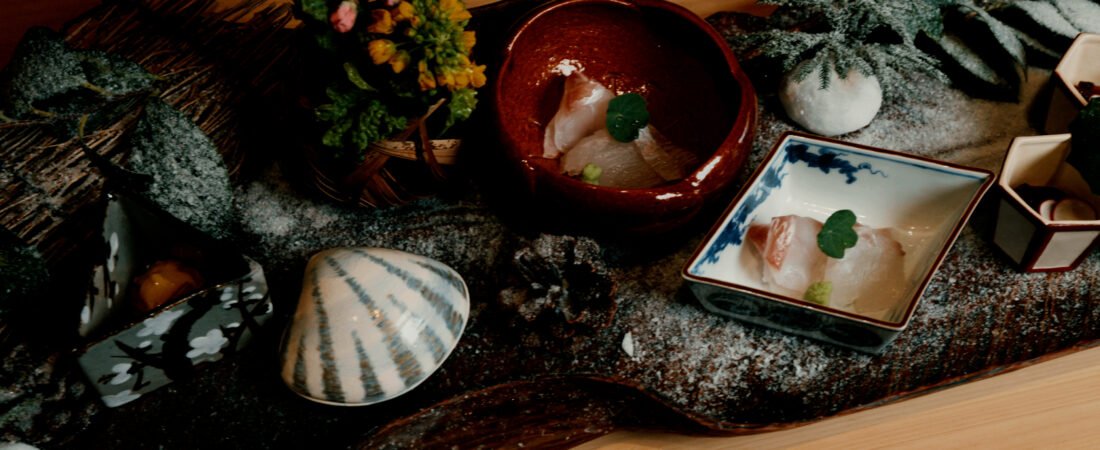
Seasonality is not only reflected in the ingredients themselves. It can also appear in the presentation, the tableware or the small details surrounding a dish.
A meal can therefore give you a real sense of the season — something that is difficult to recreate elsewhere.
Every region tells a different story
Japanese cuisine is, of course, about much more than sushi, ramen and tempura.
Every region has its own ingredients, specialities and culinary traditions. The seafood of Hokkaidō, the cuisine of Kyōto, mountain produce or the flavours of Okinawa all tell different stories.
Trying a local speciality, discovering sake from a particular region or simply learning where an ingredient comes from can completely change the way you see Japan.
Food becomes another way of travelling through the country.
The craftsmanship behind the food
One of the things that often stands out in Japan is the level of precision involved in cooking.
Preparing fish, cooking rice perfectly, making a broth or working with fermented ingredients can take years of experience.
Yet the final result can look remarkably simple.
That is what makes Japanese craftsmanship so fascinating: an enormous amount of knowledge and practice can be hidden behind gestures that appear effortless.
Rather than hiding an ingredient, the chef often tries to bring out what makes it special.
Kaiseki: discovering a story through a meal
Kaiseki is perhaps one of the clearest examples of this approach.
A kaiseki meal is not simply a series of dishes. Everything is considered as part of the whole: the ingredients, textures, temperatures, tableware and, of course, the season.
Courses arrive gradually, creating a rhythm throughout the meal. Some may be very simple, others more elaborate, but each has its place.
It is a style of cuisine that asks you to slow down.
It is also a beautiful way to experience another side of Japanese hospitality and aesthetics.
The relationship between chef and ingredient
At the heart of Japanese cuisine is also a particular relationship between the chef and the ingredients.
A Japanese chef does not necessarily want to transform a product completely. Instead, they may focus on understanding what makes it special and doing just enough to bring that out.
The preparation can change depending on the season, the quality of the ingredients or even what arrives in the kitchen that day.
As a result, the same experience may be slightly different a few months later.
The cuisine remains alive rather than fixed.
When food becomes a way to experience Japan
Perhaps this is what makes gastronomy such a meaningful way to discover Japan: it allows you to experience the culture without everything having to be explained.
You understand seasonality by tasting an ingredient at its peak. You discover a region through its produce. You see craftsmanship by watching a chef work.
And then there is the human connection.
Behind an exceptional culinary experience, there is often a person, a story and a point of view. Taking the time to meet a chef or discover their world can completely change the way you experience a meal.
The Japon Mon Amour approach
At Japon Mon Amour, we want to reveal this side of Japan through exclusively private, carefully personalised gastronomic experiences.
We are not simply looking for “a good restaurant”. We look for what could genuinely make sense for each traveller: a particular chef, an exceptional ingredient, a privileged encounter, a special occasion or simply the desire to experience Japanese cuisine differently.
Every experience is designed around the idea of privileged access. This might mean meeting a chef, enjoying a dinner created especially for the occasion, or discovering something that would not normally be accessible as part of a conventional journey.
Our goal is to create experiences with a real sense of personality, revealing a side of Japan that goes beyond the places found in guidebooks.
Because a journey is not only about the places you visit.
Sometimes, a meal, a conversation and an ingredient at the perfect moment of its season are enough to create a memory that stays with you for a very long time.